
How Pricing Intelligence Software Turns B2B Market Signals into Profit Margin
06/09/2026
13 min read
Market conditions move faster than traditional pricing processes can keep up. While competitors update prices in near real time, sales teams often quote using outdated data, manual overrides, and inconsistent guardrails. Without a governed way to continuously ingest market signals and operationalize them into quoting and contractual commitments, organizations either leave margin on the table or lose deals and renewals to more competitive offers. This isn't a dynamic pricing problem. It's a pricing intelligence and execution gap.
Pricing intelligence software closes this gap by transforming fragmented market and deal data into real‑time, actionable pricing guidance that protects margins, embedding it directly into the commercial workflows where offers are built, quotes are negotiated, and contracts are finalized.
Key highlights:
- Pricing intelligence goes beyond setting the right price. It continuously optimizes, adapts, and executes pricing decisions at scale. It analyzes market signals, past deals, product details, and account-level purchasing patterns to provide pricing guidance that helps every deal reflect current market conditions and delivers the most profitable and competitive outcome.
- AI‑driven recommendations replace reactive discounting. With price intelligence software, B2B revenue teams can stop reacting with discounts and instead use defensible, account-specific recommendations that match the market reality for each deal and product.
- Execution matters more than insight. Conga embeds pricing intelligence directly into CPQ and CLM workflows, connecting market signals to the moment of quoting and contracting across every channel.
- Every deal improves the next one. Within each customer’s own isolated data environment, transaction outcomes feed back into the AI optimization models, continuously improving accuracy, governance, and realized margin.
What Is Price Intelligence?
Price intelligence is the process of continuously collecting, analyzing, and acting on market signals such as market conditions, account purchasing patterns, historical transactions, and deal outcomes. It transforms fragmented data into real-time insights, optimizing pricing dynamically to protect margins and drive growth.
According to Market Intelo, the global price intelligence software market is projected to grow at a 16.7% CAGR through 2033, reaching $4.8 billion. That trajectory reflects a growing recognition that enterprises that act on data consistently outpace those that rely on manual processes.

B2B companies juggling thousands of products, high-volume quotes, long-term contracts, and negotiated customer agreements need more than basic revenue monitoring. Each transaction reflects a complex mix of variables, such as the buyer’s past spending, the salesperson’s discount habits, minimum margins for each category, contractual terms, and cost volatility.
Price intelligence solutions bring all these signals together to provide deal-level clarity on true profitability, not just theoretical list prices.
In practice, this means moving pricing from a static output to a continuous, decisioning system embedded directly into revenue workflows.
How the Price Intelligence Process Works
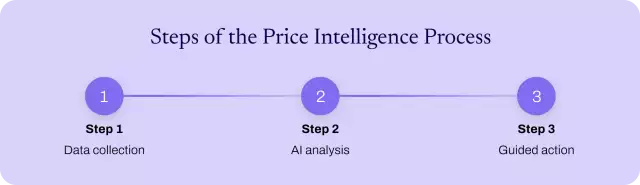
Effective price intelligence runs on a continuous three-stage loop process that aligns external market realities with financial goals and sales execution: collect competitive and market data, analyze it to identify optimal pricing, and infuse price recommendations within your quoting workflows in real time.
Collection: pricing intelligence software pulls data from multiple sources, including transaction history, commodity indices, cost structures, account segmentation, and contract terms into a centralized data layer. It’s important to note that Conga does not use personal data in its pricing algorithms.
Analysis: AI models process that data uncovering patterns, elasticity signals, win-rate trade-offs and margin opportunities, recognizing that the same product carries a different optimal price depending on the account, channel, agreement context and current conditions.
- Action: field sales, channel partners, configure, price, and quote (CPQ) tools, and digital channels receive account-specific recommendations in real time for each deal. Every new transaction feeds back into the system, making future recommendations and each subsequent quote more accurate than the last.
Most tools stop at data collection, delivering a static spreadsheet to support a basic pricing strategy. An intelligent platform handles all three steps continuously.
| Price Intelligence Stage | Data Input Source | Output |
| 1. Data Collection | Ingest, map, validate and process transactional, account, and product data into your data management tool. Note: Conga does not use personal data or PII in its pricing algorithms. | Unified pricing data model |
| 2. AI Analysis | Pull transaction history, deal-level insights, account segments, margin patterns, cost data, contract terms etc. into your pricing system | Real-time account-specific price recommendations |
| 3. Guided Action | Pull AI-optimized pricing across CPQ, partner portals, and digital channels | Competitive and profitable quotes |
Why You Need Price Intelligence Solutions for B2B Profitability

B2B pricing failures rarely come from poor judgment. They result from fragmented data and manual processes that force reps to negotiate and approve discounts with incomplete visibility on the context, and the consequences add up fast: margin leaks on deals that would have held, prices go stale across neglected SKUs, and finance spots erosion only after the contract is signed.
According to Bain & Company, organizations using data-driven pricing guidance win more deals than they lose at a rate 12 percentage points higher than competitors, and their reps are nearly twice as likely to feel confident about realizing price increases. This advantage comes from one thing: your team acting on the right market signals when they make a deal, not after it closes.

From Insight to Control: What Pricing Intelligence Changes for Pricing Teams
Pricing intelligence isn’t valuable because it produces better insights. It’s valuable because it changes how pricing decisions are made, enforced, and scaled, day-to-day.
For pricing teams, the biggest shift is moving from advisory pricing to operational pricing control.
Before Pricing Intelligence
- Pricing teams analyze data, publish guidance, and hope it’s followed
- Sales negotiates with partial context and frequent overrides
- Pricing exceptions increase as volume and complexity grow
- Margin erosion is discovered after the deal is signed
After Pricing Intelligence
- Account-specific price recommendations are embedded directly into CPQ and selling workflows, exactly when quotes are created
- Guardrails are enforced automatically at quote time, not retroactively
- AI-optimized pricing guidance is defensible, explainable and consistent
- Sales trusts insights and negotiates within approved price ranges, not guesswork
- Margin impact is visible before commitments are made, not reconciled later
This shift fundamentally changes pricing’s role in the organization: from a downstream support function to a system of decision and execution that protects margins at scale.
How Pricing Intelligence Platforms Convert Market Data into Revenue
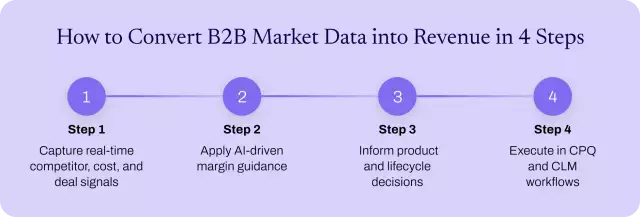
Pricing intelligence platforms bridge the gap between market noise and deal execution, protecting your margins. While the pricing intelligence process defines the “what,” modern platforms determine how that intelligence is operationalized at scale. Once pricing teams regain control at deal time, the next step is operationalizing that intelligence where decisions are made. By following these steps, you can convert raw commercial inputs into measurable financial impact:
1. Capture real-time market and deal-level signals across channels
Advanced pricing intelligence tools rely on modern data management platforms to ingest, unify, and standardize signals from across systems, channels, and business units. By bringing together product information, transaction history, CRM data, ERP costs, and digital channel inputs into a single, governed foundation, pricing teams eliminate fragmented views and manual data stitching. APIs and native integrations keep internal systems continuously connected, removing reliance on batch updates and outdated information.
This unified data hub enables faster, more accurate AI-driven analysis, giving pricing teams a complete view of each account, product, and deal context. Instead of relying on isolated data sources or aggregated averages, analysts can generate precise, account-specific pricing guidance that reflects real market conditions.
For B2B organizations managing thousands of products across direct, partner, and digital channels, this consolidation is critical. It ensures that pricing decisions are based on the full commercial picture, from customer history to cost dynamics, allowing sales teams to quote with confidence and consistency. As market conditions or costs shift, pricing can be updated in near real time, helping protect margins without waiting for manual review cycles.
2. Normalize B2B data into strategic margin guidance via AI
Managing B2B pricing data is complex, with thousands of SKUs, special customer agreements, changing costs, and lots of deal-level variables. Tools like Conga Price Optimization use neural network-based AI to analyze vast arrays of data like product and customer information, transaction trends, and elasticity signals from more millions of data points. That precision replaces broad, averaged segments with account-specific recommendations that protect target margins.
Because AI-driven pricing improves accuracy at the deal level, adoption is accelerating among organizations focused on profitable growth. McKinsey reports that 65% to 85% of B2B leaders expect to implement generative or agentic AI within three years, signaling a clear shift toward data-driven decision-making as a competitive standard.

3. Improve product lifecycle decisions with contextual intelligence
Pricing intelligence reveals more than what to charge, it provides a granular view of how products perform in the market. By tracking win rates, deal margins, and discount patterns at the SKU level, pricing and product managers identify which products exceed market tolerance, which require aligning pricing to market specifics due to positioning misalignment, and which customer segments show untapped price elasticity.
Product lifecycle insight helps guide decisions for the whole lineup. It shows which items to keep as they are, which to adjust in price, and where bundling can boost margins without cutting sales volume. Take this example: for manufacturers, looking at transaction details, these insights also shape what rebate programs to design, what volume incentives to expect, and which SKUs to keep or drop.
Explore how manufacturers optimize rebate management pricing.
4. Drive profitable growth through embedded CPQ and CLM workflows
Pricing intelligence only protects margin when it’s active during deal creation. Embedded in CPQ and contract lifecycle management (CLM) workflows, it surfaces AI-guided pricing ranges in real time based on account history, agreement context, and current market conditions. Sales reps price based on approved, up-to-date data rather than outdated spreadsheets, reducing underpricing and protecting margins.
Those guardrails carry through into the contract. Index-based adjustments and price escalators ensure the final agreement reflects the negotiated terms and preserves margins after close. With pricing, quoting, and contracting aligned in a single workflow, every deal stays within approved thresholds and eliminates leakage between quote and execution.
Connect pricing to execution to drive revenue with Conga
Pricing Intelligence Use Cases for B2B Revenue Teams
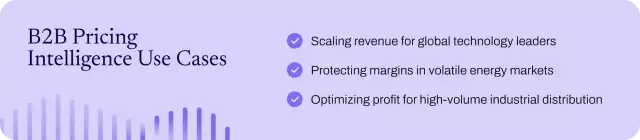
Pricing intelligence software enables B2B teams to address distinct revenue and margin challenges across industries. Consider these three use cases:
1. Scaling revenue for global technology leaders
In combination with a CPQ solution, pricing intelligence helps standardize discounting rules by embedding data-driven guardrails into the quoting process, removing approval bottlenecks for high-volume, low-complexity deals. Automating these routine transactions shifts the workload for sales teams from manual administration to strategic, high-stakes negotiations.
Case in point: a Fortune 50 enterprise technology company was losing deals to its own pricing process. An overly complex approval matrix confused partners, slowed quote turnaround to several days, and generated a high volume of unprofitable deals with significant variance.
By implementing Conga’s CPQ and Price Optimization solution, the company enabled sellers to use segment-specific, pre-approved discounts for small deals and self-service quoting for mid-size deals. This strategy allowed pricing teams to focus on large, complex transactions and apply pricing guidance and governance directly within the sales workflow. As a result:
- Quote response time decreased from several days to two hours
- Auto-approval rates increased from 10% to 80%
- 12,000 new partners joined as the quote volume more than doubled
These changes generated $400 million in incremental revenue and improved margins by 200 basis points.
2. Protecting margins in volatile energy markets
Centralized pricing integrated with analytical intelligence capabilities provides a single view of deal profitability across decentralized business units. This visibility allows your CFO to monitor margin performance across regions in real time and stop negative-margin transactions before they reach the contract stage.
A major oil and gas company, for example, struggled with inconsistent pricing in its fuels business, where independent regional units frequently signed money-losing deals. The company deployed Conga pricing tools alongside a global SAP system to bring all price-setting and analytics into a single environment.
Sales and pricing managers could now see deal profits in real time, adjust rates during the day, and negotiate better contracts. Finance teams stopped negative-margin deals by reviewing cash flows across regions in a single regional view. The result: approximately $350 million in year-over-year margin improvement.
3. Optimizing profit for high-volume industrial distribution
High-volume distributors often rely on static price lists, copied agreements, and inconsistent discounting practices, leading to significant margin leakage across large product catalogs. Conga Price Optimization addresses this by analyzing transaction history, aggregate customer behavior insights, and margin performance at scale to uncover pricing inefficiencies. Rather than relying on blanket discounting, the solution identifies where prices fall below acceptable thresholds and where opportunities exist to improve margins without impacting win rates.
Consider the case of a multibillion-dollar industrial distributor managing over one million SKUs that struggled with excessive discounting, inconsistent pricing agreements, and limited visibility into true deal performance.
By implementing Conga's pricing solution, the company was able to:
- Identify margin leakage driven by discounting patterns and inconsistent execution
- Establish data-driven pricing guidance across more than 500,000 catalog items
- Equip inside sales teams with floor, target, and stretch prices at the point of quote
This enabled more consistent, margin-aware pricing decisions, reducing reliance on blanket discounts while maintaining competitiveness. As a result, the organization moved from $4 million below to $4 million above its monthly revenue target, with an expected $18 million gain in annual gross profit.
What Effective Pricing Intelligence Enables
Effective pricing intelligence doesn’t just improve visibility - it fundamentally changes how pricing decisions are executed across the business, ensuring your pricing strategy translates into realized margin and revenue outcomes.
- Consistent price execution across channels, customer tiers, business units and regions
- Reduced discounting, fewer price escalations and less reliance on manual approvals
- Faster quote turnaround without sacrificing margin, improving customer experience and retention
- Measurable gains in margin realization, pricing discipline, and overall sales performance
Maximize B2B Profitability with Conga AI-Powered Price Optimization Solution
Conga's AI-driven price optimization connects market signals directly to pricing decisions. By analyzing transaction history, customer and product details, and competitive inputs, it generates account-specific recommendations tailored to each deal. This market-driven guidance is embedded directly into CPQ workflows, enabling sales teams to apply optimized prices at the point of quote so every deal supports profitability targets while staying competitive.
As product portfolios expand and channel complexity increases, Conga scales this intelligence across the business, reducing reliance on manual processes, improving pricing consistency, and minimizing margin leakage. For organizations looking to move from reactive pricing to governed, data-driven decisioning, Conga delivers the accuracy, control, and execution needed to drive measurable margin and revenue impact.
Contact Conga to see how AI-powered price optimization can translate into tangible financial outcomes in your environment.
Drive margin growth with Conga AI-powered pricing.
Frequently Asked Questions
-
How does a price intelligence tool work?
A price intelligence tool gathers data from sources such as market rates, transaction records, competitor signals, and cost inputs. It analyzes those inputs to generate recommendations. Basic tools stop at displaying competitor prices in a dashboard.
Advanced platforms like Conga use AI and neural networks to provide account-specific, margin-focused guidance directly within the quoting process. Sales reps get these recommendations when they need them, along with enough detail to explain pricing to customers.
-
How does online price intelligence software differ from standard pricing tools?
The key difference between online price intelligence software and standard pricing tools lies in the depth of analysis and the scope of data that inform each recommendation.
- Online price intelligence software tracks competitors' rates in real time and adjusts them for digital channels.
- Standard B2B pricing tools handle price lists, discount approvals, and contract terms.
An intelligent platform operates across both: it ingests data from all channels, applies AI analysis, and pushes optimized guidance to every selling motion, covering ecommerce pricing intelligence and negotiated B2B deals alike.
-
Who should use pricing intelligence software in a B2B organization?
Pricing intelligence software serves every role in the quote-to-cash process in a distinct way:
- Pricing managers build and maintain price models that reflect real market conditions.
- Business operations set guardrails and discount thresholds that protect margin without slowing deals.
- Sales reps quote with confidence, knowing the recommended price reflects both market data and account history.
- Finance teams track margin performance at the deal level, not just in aggregate.
-
How can price intelligence improve product development decisions?
Price intelligence shows which products are often over-discounted, which SKUs have strong margins in certain customer groups, and where bundling makes sense based on buying patterns. Product managers with this type of deal-level data can make better choices about which products to focus on, retire, or improve.
-
Why AI-Powered Pricing is Now a Business Necessity for Margin and Growth BlogAIWhy AI-Powered Pricing is Now a Business Necessity for Margin and Growth
Learn why AI pricing is becoming essential for businesses facing rising market volatility, increased pricing pressures, and growing need for agility.07/16/20267 min read -
From Pricing to Profitability: How AI is Reshaping B2B Decision-Making BlogAIFrom Pricing to Profitability: How AI is Reshaping B2B Decision-Making
Discover how AI pricing is reshaping B2B decision-making—from improving speed and margin consistency to building trust and smarter commercial strategies.06/16/20266 min read -
Building CFO Buy-in for Pricing Transformation BlogAIBuilding CFO Buy-in for Pricing Transformation
Under pressure to deliver growth, CFOs are turning to AI pricing. Discover how modern pricing improves margins, forecasts, and governance.06/16/20268 min read -
Pricing Opportunity Framework: See What You’re Leaving on the Table GuidesAIPricing Opportunity Framework: See What You’re Leaving on the Table
Estimate how much revenue your pricing process is losing and what it would take to recover it.04/06/20262 min read