What is contract lifecycle management (CLM)?
01/26/2026
15 min read
Contract lifecycle management (CLM) is the end-to-end process of managing contracts from initiation through renewal, including drafting, negotiation, execution, and compliance. If you close deals, manage suppliers, or handle business relationships, contracts are central to your daily work, governing every critical relationship your company has with customers, vendors, and partners. And a CLM system can help you automate and streamline these critical processes, reducing risk, improving compliance, and accelerating time to revenue.
This guide covers the complete CLM process and shows how a unified system transforms agreements from static documents into strategic assets that accelerate deals, reduce risk, and drive efficiency across every team.
Key highlights:
- Contract lifecycle management is the process that manages an organization's contracts from initiation through execution, performance, and renewal.
- Without a CLM system, your organization faces revenue leakage, compliance risks, and slow deal cycles due to fragmented systems and manual workflows.
- CLM enhances efficiency, accuracy, and collaboration through centralized storage, automated workflows, and real-time dashboards that help teams work faster and more accurately.
- The Conga CLM solution is an end-to-end platform that unifies contract information, integrating seamlessly with your CRM and ERP to automate workflows while ensuring compliance at every step.
What is the role of CLM?
The role of CLM is to ensure visibility, consistency, and control across every stage of the contract lifecycle. With an intelligent CLM system, you transform contract management from a disorganized, manual, and high-risk administrative process into a structured, automated, and strategic business function.
CLM technology can support your organization through every stage of the contract process:
- Creation and authoring: helping legal and business teams draft standardized, compliant contracts with approved templates and clause libraries
- Collaboration and negotiation: centralizing redlines, revisions, and approvals so multiple stakeholders can collaborate in a single system
- Execution: integrating with eSignature tools for faster signing and real-time tracking
- Storage and search: maintaining a secure, searchable repository for all active and archived contracts
- Compliance and monitoring: tracking obligations, key dates, and renewals to prevent missed deadlines or non-compliance
- Analytics and reporting: delivering insights into contract cycle times, renewal rates, and risk exposure by vendor, region, or deal type
As more enterprises recognize these advantages, the adoption of CLM continues to rise. No wonder Fact.MR reports that the revenue from CLM solutions is projected to grow at a CAGR of 12.4%, reaching $3.46 billion by 2034.
CLM benefits that enhance your contract processes
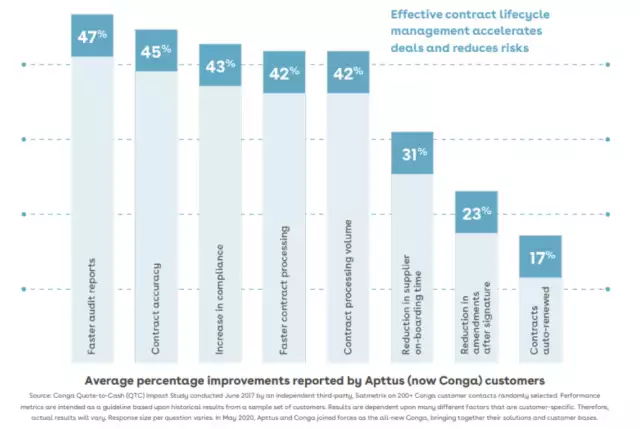
Effective contract lifecycle management solutions accelerate deals and reduce risks across your business. Case in point: our customer data shows that organizations that adopt CLM tools see measurable gains across key contract performance metrics. Here's a breakdown.
Faster audit reports
Manual audit preparation consumes time as legal, finance, and procurement teams search for contracts across disconnected systems. CLM solutions create a centralized, searchable repository, providing instant access to every agreement and its terms. This automation eliminates time-consuming manual searches, enabling organizations to deliver audit reports 47% faster and ensure prompt responses to compliance requests.
Contract accuracy
Manual drafting increases the risk of version errors, outdated language, and inconsistent clauses. CLM tools standardize the process with approved templates, dynamic clause libraries, and automated document generation, resulting in higher-quality agreements with fewer discrepancies and a 45% improvement in accuracy, according to Conga customers.
Increase in compliance and lower audit risk
Maintaining compliance across thousands of agreements is nearly impossible with manual oversight. CLM enforces internal policies, approval hierarchies, and pre-approved language to ensure every contract adheres to legal, financial, and regulatory standards. In fact, businesses that use a CLM system report 43% improvement in compliance performance.
Read more: why contract intelligence is key to legal compliance
Faster contract processing
Manual reviews, endless email chains, and approval delays slow traditional contract management cycles. A CLM solution streamlines every stage from request to execution with automated routing, real-time collaboration, and integrated eSignatures. By reducing these bottlenecks, Conga customers see a 42% improvement in processing speed.
Contract processing volume
As businesses grow, manual contract processes struggle to scale. CLM automation streamlines workflows across departments and regions, enabling enterprises to handle more agreements simultaneously, leading to a 42% increase in processing volume while maintaining quality and control standards.
Reduction in supplier onboarding time
Procurement teams often struggle with slow supplier onboarding due to manual document creation and the need for scattered approvals. CLM tools accelerate onboarding by automating template generation and routing, driving a 31% improvement in onboarding speed.
Learn how to automate onboarding to create a better customer experience.
Fewer amendments after signature
Manual drafting leads to post-signing revisions and costly rework. CLM systems maintain version control, flag deviations, and ensure only approved terms are included. This way, you can reduce the number of amendments after signing by 23%, saving time and strengthening customer trust.
Contracts auto-renewed
Manual tracking of renewal dates results in missed opportunities and revenue loss. CLM automates renewal tracking with alerts, workflows, and contract analytics that flag upcoming expirations. Enterprises that use CLM tools see a 17% improvement in renewals, ensuring continuity and long-term value.
Renewal speed and deal value
With instant access to previous terms, pricing history, and performance data through CLM software, sales teams can prioritize expiring agreements and engage customers at the best time. Automation makes the process easier, helping reps secure better terms, identify upsell opportunities, and boost both the speed and value of every deal.
Secure contract storage
When you scatter contracts across emails, shared drives, and local hard drives, security risks and inefficiencies arise. A CLM system provides a single, secure, centralized repository for all documents. This solution ensures controlled access, protects sensitive information, and makes the latest version of every agreement instantly accessible to authorized users.
Understanding the contract lifecycle management process
To understand how contract lifecycle management works, let’s take a look at each stage of the CLM process:
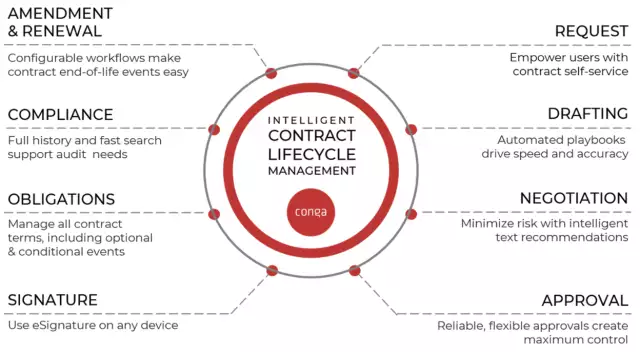
1. Request: a business user asks for a contract
Without a CLM solution, this step is informal and inconsistent, relying on emails or outdated templates. A CLM system replaces that with a guided intake process that captures all required details and routes the request to the right team. With a solution such as Conga CLM, you can:
- Use standardized request forms and templates by contract type
- Automatically route requests based on defined service levels (SLAs)
- Eliminate errors and delays caused by incomplete information
Impact on your organization: With a consistent, structured process request, you keep contracts moving quickly and minimize risk and rework, setting the foundation for faster deal cycles and improved compliance downstream.
2. Drafting: a contract is created
Drafting contracts manually is slow, error-prone, and often dependent on legal teams. The CLM solution accelerates this stage with pre-approved templates and clause libraries, enabling the automatic generation of agreements and ensuring accuracy and compliance from the outset. Key advantages include:
- Automate contract creation using approved templates
- Integrate directly with Microsoft Word for legal review and collaboration
- Allow business users to generate low-risk contracts without legal delays
Impact on your organization: Accurate, compliant contract drafts reduce legal bottlenecks, prevent errors, and ensure agreements reflect company standards, saving time and protecting revenue.
3. Negotiate: terms are agreed upon between parties
Negotiation includes pricing, service levels, liabilities, renewals, and intellectual property. Managing these details through emails or shared files causes version confusion and missed edits. Contract lifecycle management systems enable you to:
- Track redlines and revisions automatically across all versions
- Compare documents side by side to identify and resolve changes
- Maintain a complete audit trail for transparency, accountability, and compliance
Impact on your organization: Clear, organized negotiations mitigate disputes, accelerate approvals, and align all parties, strengthening relationship outcomes and reducing risk
4. Approval: internal controls ensure the best outcome
In this stage of contract lifecycle management, sales teams want to move fast, while legal and finance teams must safeguard the future of compliance and mitigate risk. By automating routing based on contract type, value, or risk level, a CLM system ensures the right reviewers take action without delays. With a CLM, you can:
- Automate approval routing based on predefined rules
- Eliminate email bottlenecks and manual follow-ups
- Approve contracts securely from any device and from anywhere
Impact on your organization: Efficient approvals cut cycle times, eliminate bottlenecks, and guarantee compliance with internal standards, shielding the business from risk.
5. Execution: the contract is signed, put into effect, and placed in a repository
CLM solutions such as Conga Sign simplify approvals and automatically store the finalized agreements in a secure repository. This automation ensures:
- Faster time-to-signature and immediate activation of terms
- Secure storage of executed contracts in one centralized location
- Complete visibility through digital audit trails
Impact on your organization: Seamless, secure contract execution ensures every agreement is enforceable and auditable from day one, reducing administrative overhead and compliance risk.
6. Obligations: ensure both sides meet their end of the agreement
Both parties must fulfill the terms of the agreement, including delivering goods, meeting milestones, and processing payments. Manual tracking leads to missed deadlines and compliance issues. With CLM software, you:
- Assign ownership of obligations and milestones to specific teams
- Sync contract data with CRM and ERP systems for real-time updates
- Automate alerts and reminders to prevent missed deadlines or payments
Impact on your organization: Proper contract obligation management prevents penalties, maintains strong client relationships, and ensures revenue and deliverables are realized on schedule.
Keep learning: How to manage your contractual obligation to gain a strategic advantage
7. Compliance: meet all reporting, search, and government requirements
Organizations must demonstrate adherence to internal policies, industry standards, and government regulations. Manual tracking becomes difficult when you scatter agreements across multiple systems. A CLM solution simplifies compliance by enabling teams to:
- Search and filter contracts by clauses, terms, or performance metrics
- Generate real-time reports for audits and regulatory reviews
- Maintain a complete, searchable repository to reduce compliance risk and response time
Impact on your organization: Effective compliance reduces legal exposure, simplifies audits, and ensures confidence with regulators, investors, and internal stakeholders.
8. Amendment and renewal: contracts are changed and renewed, then the cycle starts over
As contracts near expiration, renewal discussions trigger new rounds of drafting and approval. Without automation, you miss renewal dates, rush last-minute signatures, or let agreements expire altogether. A CLM system streamlines this process by:
- Sending proactive alerts before expirations or required revisions
- Allowing teams to quickly locate and update contracts that need amendment
- Automating contract renewals with approved templates to reduce delays and ensure accuracy
Impact on your organization: Automated renewals and amendments prevent revenue loss, improve customer retention, and ensure contracts remain accurate.
Watch our renewal management demo to learn how Conga can help.
8 common contract lifecycle management challenges—and how a CLM system solves them
Contracting has become a barrier to strategic execution. Legal, procurement, and sales teams face pressure to manage contract lifecycle risk, ensure compliance, and deliver results more efficiently—all while navigating complex regulations and high volumes of contracts. According to a collaborative study by KPMG and WorldCC, only 11% of organizations consider their end-to-end contracting process to be very effective.
Here are eight common contract lifecycle management challenges and how CLM software solves them:
| CLM challenge | Impact on the business | CLM solution |
| 1. Slow and manual contracting | Manual reviews, inconsistent language, and excessive approval steps delay deals and increase errors, turning legal into a bottleneck that slows procurement and sales |
|
| 2. Limited contract visibility | Contracts scattered across systems make it hard to track performance, assess risk, and manage renewals |
|
| 3. Compliance and audit risks | Inconsistent language and overlooked obligations cause audit failures and compliance gaps across all company departments |
|
| 4. Disconnected systems and silos | When teams work in disconnected systems, the result is duplicated data and slow handoffs between departments |
|
| 5. Lack of scalability | As contract volumes grow, legal teams can’t review every contract manually, limiting agility and delaying execution |
|
| 6. Missed renewals and terminations | Missed renewals and unmanaged terminations cause revenue leakage and increased costs |
|
| 7. Unreliable AI solutions | Poorly implemented AI features create inaccurate outputs, compliance gaps, and a higher risk |
|
| 8. Foundational gaps in the CLM process | Reliance on spreadsheets and email leads to missed renewals and compliance failures |
|
Contract lifecycle management solutions from Conga adapt to your business needs—offering core features such as centralized storage and automated alerts for teams just beginning, as well as advanced automation, AI-driven insights, and seamless system integration for organizations ready to grow.
See how Conga CLM can solve your contract challenges
What teams use contract lifecycle management software and why?
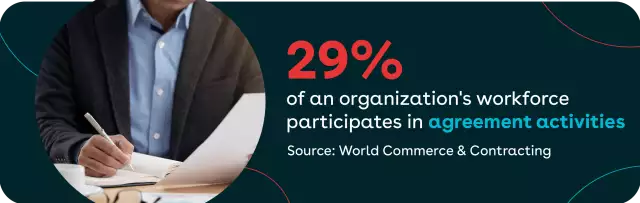
Teams across departments use contract lifecycle management systems to centralize agreement processes, streamline collaboration, reduce risk, and accelerate business outcomes. Per the WorldCC report, 29% of the workforce is actually involved in contracting.
| Team | Why use CLM software | Benefits of CLM tools |
| Legal | To standardize contract language, enforce compliance policies, and gain visibility across all agreements |
|
| Sales | To accelerate quote-to-contract cycles, automate agreement generation, and manage renewals directly in CRM systems |
|
| Procurement | To streamline supplier onboarding, enforce vendor compliance, and track performance obligations |
|
| Finance | To align contract terms with billing, payment, and revenue recognition for accurate financial reporting |
|
| Business operations | To manage service-level agreements, track cross-departmental performance obligations, and ensure operational excellence |
|
| IT | To enforce technical and security requirements in vendor contracts and ensure seamless integration with enterprise systems (ERP and CRM) |
|
| Healthcare | To manage payer, provider, and vendor contracts while ensuring compliance with HIPAA, Stark Law, and other regulations |
|
Read more: 10 must-have contract management software features.
To maximize your investment, minimize risk, and transform your contract portfolio into a strategic asset, follow these contract lifecycle management best practices:
- Get your contracts in one place: gather all your contracts into a single, secure digital repository. This approach creates a single data source that unlocks the ability to search, report, control access, and receive automated alerts for key dates.
- Automate routine workflows and approvals: replace manual reviews with automated routing rules that send contracts to the right stakeholders based on value, region, or risk level. Automation accelerates cycle times, eliminates bottlenecks, and ensures nothing stalls in review.
- Use pre-approved templates and clause libraries: build a library of standardized templates and clauses for frequently used agreements. This approach promotes consistency, ensures compliance, and lets legal teams focus on complex or high-value negotiations instead of repetitive edits.
- Integrate CLM with existing enterprise systems: connect your CLM with core business platforms, such as CRM, ERP, and eSignature tools, to eliminate silos. Integrated systems keep data synchronized, reduce duplicate entry, and align contract information across teams.
- Track obligations and performance post-signature: monitor key deliverables, milestones, and renewal dates through your CLM. Continuous visibility helps teams meet commitments, mitigate compliance and contract risk, and use contract data to negotiate stronger future terms.
Transform contract management with Conga CLM
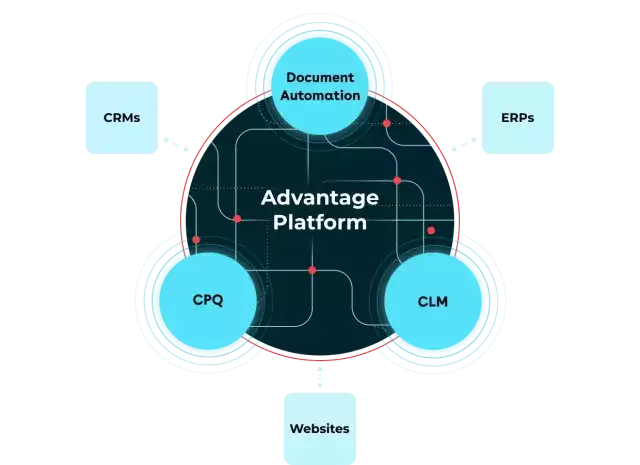
Conga’s CLM solution is designed to meet your business wherever you are in your contract management journey and scale as your needs evolve. We begin by building a strong foundation through centralized contract storage, automated expiration tracking, and configurable alerts that bring order, visibility, and control to your contract portfolio.
As your needs grow, our CLM transforms contracts from static documents into dynamic, data-rich assets by consolidating information across CRM, ERP, and procurement systems, automating end-to-end workflows, and integrating compliance at every stage.
With AI-powered contract management, clause validation, and real-time dashboards, legal, procurement, and sales teams can collaborate seamlessly, reduce risk, and accelerate execution. Conga CLM drives contract excellence at scale, shortens cycle times, improves negotiating outcomes, and minimizes risk.
Ready to transform your contract management?
Frequently asked questions
-
What is a contract lifecycle management system?
A contract lifecycle management system is an integrated, end-to-end software solution designed to systematically manage every phase of a contract, from the initial request through drafting, negotiation, execution, obligations, compliance, and renewal. The system's primary role is to transform contracts from static, high-risk documents into strategic assets by providing visibility, automation, and control across the entire process.
-
What types of contracts can you manage with CLM software?
CLM software manages any type of contract, including:
- Sell-side contracts: agreements that the sales team manages, focusing on revenue generation.
- Buy-side contracts: documents that the procurement and finance teams manage, focusing on cost control.
- General contracts: supporting business units such as HR, operations, IT, and R&D use this agreement.
-
How can I automate our contract lifecycle management?
You can automate your contract lifecycle management by implementing a CLM software platform that streamlines every stage of the contract's journey. Follow these steps:
- Use pre-approved templates and clause libraries to create consistent, compliant contracts, eliminating manual drafting errors
- Configure automated routing rules to send contracts to the right stakeholders based on value, department, or risk level, cutting approval time
- Integrate electronic signature capabilities to execute agreements instantly, removing printing, scanning, and physical delivery delays
- Set up intelligent alerts for key dates, renewals, and compliance milestones, ensuring nothing gets missed after signature
- Implement intelligent clause recommendations and risk flagging to accelerate negotiations while maintaining compliance standards
-
How does contract lifecycle management facilitate collaboration?
Contract lifecycle management services enable collaboration by providing a unified platform where all stakeholders (sales, legal, and finance) can access, draft, negotiate, and approve agreements. Instead of relying on manual processes, email, and dispersed documents, users can track changes in real time on the platform, improving cross-functional visibility and ensuring consistency across all negotiations and stages of the contract's lifecycle.
-
How does contract lifecycle management software support compliance?
Contract lifecycle management (CLM) software enforces compliance by embedding approved language into templates, automatically routing contracts for legal review when non-standard terms appear, and providing complete audit trails. The system also alerts teams to regulatory changes and ensures obligations are tracked and met.
-
Is CLM difficult to implement?
No. Modern solutions, such as the Conga platform, are designed for manageable CLM implementation. Begin with core features, such as centralized storage and basic workflows to achieve quick wins, then add advanced functionality as you scale. With proper planning and stakeholder alignment, you will see value within the first few months.
Learn how to accelerate your CLM implementation with Conga Professional Services.
-
Contract lifecycle management system (CLM) and contract management system (CMS): what's the difference?
A contract management system (CMS) focuses on the repository and storage aspects of agreements, while a contract lifecycle management (CLM) system governs the entire end-to-end process.
Points of comparison CLM solution CMS solution Scope Full lifecycle coverage, including pre- and post-signature stages Repository and storage of executed agreements Functionality Process automation and contract obligation management capabilities Document storage and organization features Integration Connectivity with CRM, ERP, and other enterprise systems Standalone repository without external integration -
What's the difference between CLM and CRM?
Customer relationship management (CRM) focuses on customer interactions and sales pipelines, while contract lifecycle management (CLM) governs contract creation, execution, compliance, and performance tracking.
Points of comparison CLM tool CRM tool Focus Governance of contractual terms, risk, and compliance Management of customer relationships and engagement Key function Contract risk management, compliance, and obligation tracking Lead tracking, pipeline management, and customer support Relationship Execution and oversight of formal business agreements Generation and tracking of potential business opportunities -
What is the difference between CLM and ERP?
Contract lifecycle management (CLM) and enterprise resource planning (ERP) systems handle different aspects of business operations, but work best when integrated.
Points of comparison CLM ERP Focus Oversight of contractual terms, obligations, and commitments Management of financial and operational processes Key function Definition of business rules and legal requirements Execution of financial transactions and resource allocation Relationship Establishment of terms that guide operational activities Enforcement of contractual terms through business operations
Resources
-
What is Contract Management and Why Is It Important? BlogCLMWhat is Contract Management and Why Is It Important?
Contract management is a crucial aspect of any business operation. It refers to the process of creating, negotiating, and executing contracts to ensure that all parties involved fulfill their contractual obligations.10/16/20235 min read -
Contract Risk: What Is It, Most Common Types and How To Asses It BlogDocument AutomationContract Risk: What Is It, Most Common Types and How To Asses It
Managing contracts can be complicated—and risky. But what makes a contract risky? How can you assess these risks to mitigate them ultimately? There are contractual risks associated with any contract a business enters into. Still, some tools can help you manage contracts, identify, and assess risks to protect the integrity of your business.11/09/20225 min read -
Ultimate guide to contract management GuidesCLMUltimate guide to contract management
Learn more about how effective contract management can help you streamline processes, maximize deal values, and reduce risk.
10/10/20200 min read -
The 5 pain points of inefficient contract management BlogCLMThe 5 pain points of inefficient contract management
If contracts are done faster, you’re able to collect on them sooner. If they’re accurate, you have fewer disputes and fewer time-wasting contract revisions. Generals counsel and C-level executives will sleep better at night because they have confidence that the contract management process is working.08/01/20193 min read